Pages

Monday, March 26, 2012

Take the Journey to No Coding through Configuration and Composition

This blog post is also posted on the Documentum Blog on the EMC Community Network.
Since its early days, Documentum has recognized the need to track and manage intellectual property and information. In the mid-1990s, Documentum focused on solving these customer problems targeting one industry at a time. It targeted manufacturing for managing training publications and life sciences for automating the process of assembling new drug applications.  The result of this approach was a variety of custom applications that provided significant value to a specific business area but were not easily re-purposed in other areas.

Today, EMC Information Intelligence Group (IIG) customers have more complex information management needs and the end users of these applications have become much more demanding. The new user, as we like to call her, is impatient. She has work to get done. She needs simplicity, ease of use and anywhere access to information. The business on the other hand requires more sophistication and control. And they want their investment to matter.  They want people to use that application they just built…

So, what we see is our customers seeking the powerful benefits of highly tailored clients and applications with custom functionality, and automated, integrated business processes. As if this new user shift was no hard enough, it is also compounded by increasing economic pressure on the buyer and IT. These factors are what have shaped our Documentum clients and application strategy. We are doubling down on configuration and composition and taking our customer on a Journey to No Coding.

Why? And what is composition anyway? And how is it different from configuration?

Through composition, our customers can leverage an integrated application building environment that enables them to rapidly deliver a highly tailored business application combining ECM and BPM.   That’s the value offered by EMC Documentum xCP.  xCP applications are easily upgradeable, leverage built-in best practices, and provide significant business value for applications that integrate content, process, people, and systems.

For most ECM requirements, we recommend configuration with EMC Documentum D2.  Unlike an application built with xCP, which is tailored for a particular business process, D2 is a general purpose ECM client designed by EMC IIG.  Where other ECM clients provide an API for customizing the application, D2 can be rapidly configured, with no coding, to satisfy 80%+ of your ECM needs.  The result is superior user experience and consistency with minimal effort to maintain, enabling tremendous time to value.

The Ideal Content Platform

Sounds too good to be true?

Try it for yourself. Both D2 and xCP are available today, and our team is hard at work to take that story to the next level this year.

So, will you take the Journey to No Coding with us?

Sunday, July 10, 2011

Search: A Key Building Block for Business Applications

As I wrote previously, the ECM market is going through significant transformation and continued consolidation.  The convergence of 4 different markets are contributing to this evolution.  One of the interesting aspects of this transformation is the emergence of search as a key enabler for business applications.

Basic Premise

Future winners in the evolving ECM market will need to embrace new composition frameworks that can rapidly deliver solutions at the intersection of content, social, search and analytics, and business process management.  Those composition platforms will also need to support hybrid cloud delivery models to deliver optimal business values based on the customer needs.

Search and the Composite Application Platform

The concept of search based applications is defined by Sue Feldman and her team at IDC as "applications that combine search and or text analytics with collaborative technologies, workflow, domain knowledge, business intelligence or relevant web services".

The definition above introduces key distinctions from the traditional definition of search:
  1. Search based applications combine a broad range of capabilities:  I find this aspect of the definition particularly interesting.  From my perspective, this makes search technology one of the building blocks of an application composition platform.  It offers both information management capabilities such as information categorization, text mining, indexing, fuzzy matching and information navigation capabilities such as faceted / relational navigation and data visualization in the context of business applications.
  2.  
  3. Information is integrated with business processes: this is a critical aspect of search based applications and this is where I believe there is strong overlap with decision management or case management.  In a business context, search supports a decision process.  Those decisions might be more project centric which will require more collaboration and ad-hoc discovery.  They might also be more process or case centric in which a network of processes will manage the orchestration of the decision process.
This requires that search capabilities be weaved into the fabric of business applications.

What about some examples?

First let's look at some examples for best of breed search vendors and how they leverage the concept of search based applications to address their customer problems.

New account opening and single view of the customer

Attivio provides the case study of a large global bank challenged to enhance customer service across 40 countries, 50,000 employees and 100 separate sources of information.  The bank decided to leverage a search based application to provide a unified view of customers resulting in the enhanced productivity of the customer facing agent, improved customer experience, and a higher percentage of first call resolution rates, while decreasing overall support and maintenance cost.

Warranty and quality monitoring

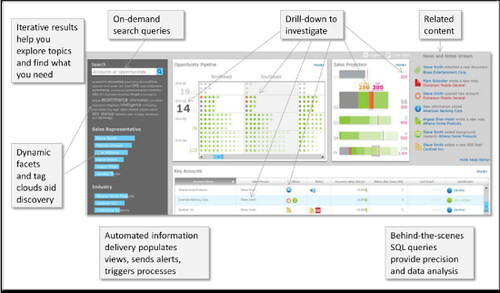
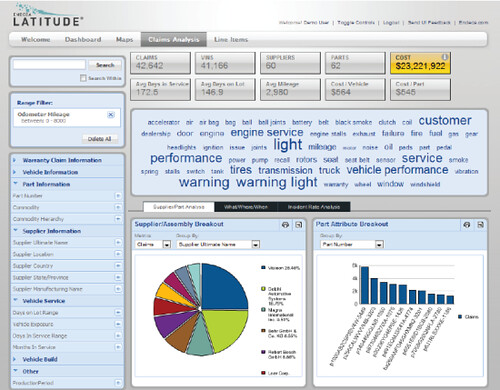
High warranty costs have received significant exposure lately. Think about Johnson and Johnson having to recall 22 products in 19 months adding up to over $900M in revenue loss.  Those are nightmares manufacturing executives cannot ignore.  Getting the information to identify warranty issues before those organizations are at risk requires visibility throughout the entire supply chain.  By integrating data from multiple sources, search based applications provide the right tools to support the discovery and early identification of product quality issues.  Endeca offers Endeca Latitude for Warranty to address this problem.

A New Kind of Business Application Composition Platform

The examples above illustrate the power of search based application.  Those applications become even more powerful when they are combined with an action engine that enables the tracking and processing of warranty issues, the collaboration on criminal investigations or complex financial products.  With xCP, our view is that great search and data visualization capabilities need to be combined with the orchestration of content and information that will drive optimal business decisions: for instance a product recall based on the early identification of warranty issues.

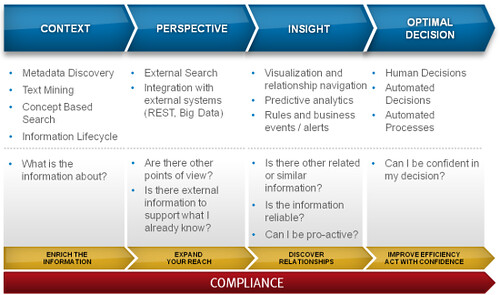
Samir Batla, product manager for search and analytics at EMC IIG has posted a series of blogs posts on how xCP exposes a wide variety of technologies that enables optimal business decisions and how from early warnings, customers can take action to make pro-active decision for their businesses.  As shown below, the anatomy of an optimal business decision requires much more than search.  The combination of the broad set of capabilities of xCP is what enables these optimal business decisions.

Monday, June 13, 2011

The Need for Cloud Integration

The cloud is everywhere those days and the software industry is going through some drastic transformations.  According to IDC, “Software as a Service 2010-2014” report, software will never be the same.  The on-premise software market will go down 19% during this period from a market share of 66%.  In the same period, shares of the public cloud are expected to go up 12% to 22% of the software market revenue.  The Platform as a Service market is expected to grow between 39% and 55% a year for the next 5 years (IDC forecast vs. Forrester forecast).  This is quite some shift...

Forrester Research defines Platform as a Service (PaaS) as:
A complete application platform for multitenant cloud environments that includes development tools, runtime, and administration and management tools and services. PaaS combines an application platform with managed cloud infrastructure services.
A key value of PaaS is the ability to focus on the business application and not on platform technologies.  As PaaS becomes more widely adopted and business applications increasingly built on top of such platforms, the need for cloud integration will become pervasive.

Modern applications require the ability to expose enterprise information in the context of the task at hand.  Adaptive contextual user experiences will become increasingly critical for business users to rapidly make optimal business decisions.  In a PaaS or SaaS world, this will require robust integration with the needed information sources such as:
  • Cloud based applications: CRM systems like Salesforce.com, HR systems like Success Factor or Workday, public cloud email systems and productivity applications
  • Enterprise applications:  ERP systems like SAP or Oracle Business Applications
  • Content management systems internally hosted or in the public cloud
  • Legacy systems and applications
However, cloud integration as some serious challenges it needs to overcome.  A July 2010 survey by Saugatuck Technology confirms that data security and privacy as well as data integration concerns are top concerns in deploying cloud based business solutions.

Cloud Challenges

Let’s have a look at some of those challenges:
  • Data integrity and information security.  Art Coviello from RSA articulates the problem nicely:  "While cloud computing offers tremendous benefits in cost and agility, it breaks down some of the traditional means of ensuring visibility and control of infrastructure and information. Forcing enterprises to develop trusted relationships individually with each cloud service provider they wish to use is cumbersome and will not scale. New thinking in security and compliance is required to provide a future in which organizations can consume services from a wide variety of cloud service providers on-demand and for all their application needs." 
  • Application security integration.  Anyone who has tried to integrate applications together knows that one major integration issue is around access control and particularly role based security.  Protocols  like OAuth have emerged to provide a simple way to publish and interact with protected data.  Other standards like XACML provide flexible solutions for enforcing granular authorization.  Unfortunately, those technologies are not broadly adopted by enterprise application making authorization integration a challenge.
  • Data integration.  Many enterprise systems still require proprietary integration mechanisms.  But even cloud based applications require integration with their proprietary APIs.  Cloud based integration should provide a flexible mechanism for data mapping and integration.  As Mark Brennan, Director of Business Applications at Pandora puts it: "traditional approaches to integration are no longer adequate when you have literally dozens of SaaS applications, all needing to talk to each other. If every change, customization or refinement becomes a project, we can’t keep up. To changes all that, we need a solution that elevates us out of code level and putting the power directly into our hands".   Some of those data integration challenges may involve:
    • Bi-directional data synchronization
    • Transactional integrity and service orchestration
    • Solutions to deal with information caching and system latency
Clearly, addressing those challenges will be key to enterprises moving and trusting their enterprise systems to the public cloud.

Saturday, June 04, 2011

A New Platform to Deliver Superior Customer Experiences

A few weeks ago, I talked about the new platform and the new technology era of business applications. The new platform must enable business applications to drive optimal business decisions and improve customer experiences. It must provide a breadth of application services that enable businesses to rapidly build intelligent business applications that can adjust rapidly to changes in their business environment.

Several weeks ago, at EMC World 2011, I gave a presentation on How to leverage Documentum xCP and the 5 Cs (correspondences, capture, case, content and compliance) to deliver superior customer experiences while improving business efficiencies.


In my presentation I started with a personal experience. A few months ago, I got an automated phone call from my bank telling me that my debit card had been deactivated and to press 1 if I wanted to reactivate it. Puzzled, I decided to call my bank instead. First, regular customer services was closed; so I decided to get routed to the service where you report card losses. After a 15 minute process, I finally got in touch with a customer representative who told me that this was a scam they were aware of and that they had issued a press release to warn their customers about the scam. Yes, you read right: a press release... As educated and responsible consumers and customers, we are expected to monitor the press releases of the companies we do business with, no less.

Well, in the day and age of personalized services and hyper social interactions, needless to say we expect more. This is where the new platform comes into play.  Imagine what my bank could have done had they been using that new platform:
  1. They could have been monitoring social channels and their own customer data to look for patterns that their brand was being used for mischievous purposes.  That's where Big Data comes in.   Leveraging data computing appliances and predictive models, corporations can be on the look for significant patterns or events that are likely to impact their businesses.
  2. Once, my bank has found evidence that a scam is underway, they could have leveraged the intelligent correspondence management and process capabilities of xCP to send me multi-channel personalized communications and to make sure that I was aware of the scam.  In those communications, they would have provided me with instructions on how to deal with the situation.
  3. They could have been proactive in identifying customers that were victims of the scam and opened cases to help those customers deal with the situation, cancel their debit cards and issue new ones
  4. They would be delivering better customer experiences, ensuring the loyalty of their customers while protected their business against potential charges of negligent behavior.
This is the power of the new platform.  Gain insight from social and business data, and take actions on that insight to deliver superior customer experiences.  As the success of companies like Zappos shows, companies that can successfully deliver those superior experiences create long term sustainable competitive advantage.

Saturday, May 28, 2011

The Evolution of the ECM Market

When Documentum was founded, the founders' vision was to manage the world's information to enable innovation and scientific breakthrough (like finding a cure for cancer). Since then, what started as a Document Management opportunity has gone a long way. Today, Enterprise Content Management is a mature market providing breadth of technologies that enable organizations to reshape the way project or transactional decisions are made. The ECM market is also a market that has gone through significant transformation lately and continued consolidation.

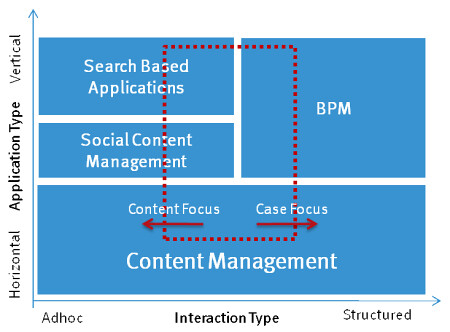
I see the convergence of 4 markets contributing to the evolution of ECM targeting different interaction types (from adhoc to structured) and application types (from horizontal to vertical).

The Evolution of ECM

The Commoditization of Content Services

The unprecedented success of Microsoft SharePoint has commoditized content services and significantly changed the content management market. SharePoint is now a force to be reckoned with. The sprawl of SharePoint sites has also created tremendous opportunities for information governance and given rise to a new generation of anti-SharePoint offerings such as Box.net leveraging the cloud to simplify information sharing.

The Emergence of Social Business Platforms

With the launch of their new Alfresco Enterprise release, Alfresco embraced the concept of Social Content Management. Jive and IBM refer to the same opportunity as Social Business. Whatever the term, in its latest magic quadrant, Gartner recognizes the impact of social interactions as social media create masses of unmanaged content.

Jive and IBM are the clear leaders in Social Business Platforms and the recent partnership between Jive and Alfresco recognizes the need for Social Business Platforms to provide robust content management capabilities. Social Business Platform vendors like Jive have been successful against Microsoft by focusing exclusively on social features and how they can help certain types of employees (salespeople, developers, etc.). Microsoft has also recognized the impact of social on content management and collaboration with SharePoint 2010.

Vendors for Social Business Platforms include: Jive, IBM, Microsoft, Cisco Quad, Acquia / Drupal

When ECM Meets Search Based Applications

The concept of search based applications is defined by Sue Feldman and her team at IDC as "applications that combine search and or text analytics with collaborative technologies, workflow, domain knowledge, business intelligence or relevant web services". This definition is being embraced by search vendors such as Endeca, Sinequa and Exalead (now part of Dassault Systemes). Gregory Greffenstette, Exalead chief science officer, offers a glance into concrete examples of search based applications from logistic track and trace type applications, to CRM, 360 view of the customer and decision intelligence.

At EMC, we have recognized the importance of search based applications and are incorporating search and text mining functionality into our products from CenterStage to Documentum xCP leveraging our Documentum xPlore, Content Intelligence Services and Federated Search Services, now core features of the EMC Documentum Platform.

Other ECM vendors from OpenText to IBM have recognized this trend as well with significant investments and acquisitions in this area. Key to delivering the promises of search based applications will be tight integration with composition tools for a new breed of business savvy developers that will enable the rapid creation of search enabled applications.

The following search vendors have embraced this trend: Autonomy, Microsoft / Fast, Attivio, Endeca, Sinequa, Exalead (Dassault Systemes)

Towards Composite Content Application Frameworks and Dynamic Case Management

As Gartner points out in its latest magic quadrant, there is increasingly more pressure on ECM vendors for ready to use solutions which solve real business problems rather than generic content platforms composed of dozens of loosely coupled modules. The need for more business solutions coupled with the convergence of the ECM and BPM markets has seen the rise of new opportunities for what Gartner calls Composite Content Application frameworks and Forrester calls Dynamic Case Management. While composite content application frameworks address the needs of content solutions, dynamic case management focuses on the convergence of ECM, BPM, business analytics and event processing. The reality is that there is a spectrum of solutions from content to case that require a new generation of composition tools to rapidly deliver business value with the agility to evolve quickly as business needs change. Organizations need more than a repository, they need an application platform and the solutions that come with it.

The following vendors provide composite content application platforms: EMC Documentum xCP, IBM, OpenText, Adobe, SpringCM, Hyland, Nuxeo

Towards the New Information Fabric

As the delivery of composite content application platforms transition to the cloud, this creates an opportunity for a new information fabric that will deliver tremendous business value and flexibility while reducing barriers to adoption. The industry is clearly at an inflection points in the adoption of cloud services. While Public cloud services offer tremendous promises, hybrid cloud deployments are most likely to provide the right balance between information control and flexibility.

Future winners in the evolving ECM market will need to embrace new composition frameworks that can rapidly deliver solutions at the intersection of content, social, search and analytics, and BPM (from content to case). Those composition platforms will also need to support hybrid cloud delivery models to deliver optimal business values based on the customer needs.

Do you share this perspective on the evolution of ECM market? Share your thoughts on this blog or on twitter.

Saturday, May 21, 2011

The New Technology Era of Business Applications

After a long hiatus, I have decided that it was time to start blogging again. Last time I posted a blog post was more than 2 years ago. Time flies...

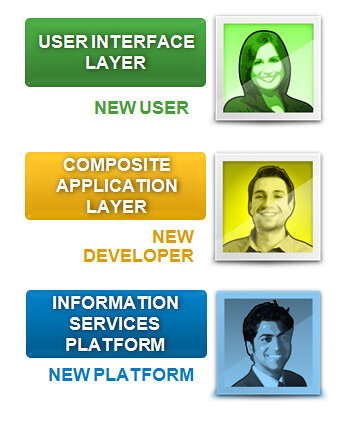
We live in an exciting technology era. Technology transformation is accelerating and what is unique about this transformation is that all layers of the technology stack are experiencing significant changes at the same time. Jeetu Patel wrote a good blog post introducing the Post PC-era. For business applications this has significant implications.

  1. The new platform: Business applications require a new platform. That new platform must be scalable, elastic, and rapidly respond to the needs of the business. It also needs a rich set of services to enable businesses to rapidly deliver applications that meet their most critical needs. At EMC Information Intelligence Group, we are investing on both those fronts:
    1. At EMC World, we announced EMC OnDemand to take EMC Documentum into the New Platform era.
    2. Documentum xCP was mentioned in every one of our executives keynotes (by Joe Tucci, Pat Gelsinger, Paul Maritz). xCP provides the breadth of services that enables to rapidly deliver business applications that meet the critical needs of the business. At EMC World, I had a presentation on leveraging the 5Cs (correspondence, capture, case, content and compliance). Those are cornerstone services for the new platform.
  2. The new developer: The new developer needs new tools to create applications at a new level of abstraction and to enable her to focus on solving business problems rapidly and not as much on coding or the technology. The new developer needs powerful composition tools. Check out how xCP can empower the new developer to rapidly create sophisticated business applications.
  3. The new user: Choice computing is critical to the new user. Check out Jeetu Patel's Blog post on the new user. The new user wants pervasive access to information, user interfaces that are catered to her needs. She needs to make decisions rapidly and needs the right insight to make the right decision with confidence. To that effect, EMC IIG had some significant partnership announcements at EMC World. But beyond the right user interface, the new user needs instant access to the right data, with the insight that enables her to take the right action. She needs to be able to turn information into business advantage. I presented at EMC World on how xCP can enable the new user to do just that

The New Stack

Those are exciting times at EMC IIG, the innovation machines is humming and we are taking part of the transformation of the business application platform on those 3 fronts. This represents an incredible opportunity for the future. I am exciting to be part of this transformation and to lead the development of next generation technology that will enable it.

Saturday, November 15, 2008

Business and Cultural Challenges of a Next Generation Collaborative Solution

Cross posting from my blog post on the EMC Knowledge Worker blog.

Last Monday, at Momentum Prague 2008, I held a Product Advisory Forum (PAF) with 27 EMC customers. The overall objective of the Knowledge Worker PAF was to assess the characteristics of a next generation collaborative solution. As an introduction, we reviewed a set of disruptive trends around:
  • The changing nature of the Enterprise
  • New work habits, social and cultural changes
  • Disruptive technologies that support new patterns of collaboration
  • The impact of the changing economic climate
See the presentation for more details on each trends.

3 teams of participants were then asked to assess business, cultural challenges and solutions that would help their organizations adapt to such trends.

Overall Needs and Business Challenges
The following needs and business challenges were identified:
  • Organizations need to improve collaboration within their organizations and with external parties. This raises issues around the proper level of openness and how to balance such a need against the needs for better security.
    • Open systems are necessary to enable expertise location and finding information
    • Integration between enterprise services is required to break information silos and encourage collaboration across various types of content in the enterprise
    • Improving connections between people and content provides additional context to the information and fosters better interaction between knowledge workers
  • Organizations need to improve the use of information structures and reuse of already existing information
    • Formalizing knowledge within organizations can improve its reuse. In order to do so, organizations needs better mechanisms for classifying and organizing information. Both taxonomies and folksonomies have a role to play.
    • Reusing content in new ways can open new business opportunities and improve the speed of delivery of new projects.
    • Organizationally, there is no substitute for producing lessons learned and synthesizing information. Organizations need to adopt models that encourage information reuse and developed template based information models.
      • This provides a framework for producing new quality information more quickly and on-ramping on new subjects and projects more quickly.
  • How do organizations make sure that the information they manage is valid and of quality and how do they effectively manage their information lifecycle?
    • Organizations can rely on informal validation where the collective intelligence of the community can be leveraged to produce and elevate the most valuable information
    • In parallel, some categories of content will never be properly assessed by the community. Formal processes are required for such content (e.g. Standard Operating Procedures)
    • In addition, organizations need to put systems and policies in place that preserve information readability over the years and retain only content that is relevant to the organization. How does an organization properly identify the content that needs to be retained, in particular when it pertains to the organization knowledge?
    • Organizations should look at technology that helps with concepts extraction and leverages such capabilities for improved information classification
  • Organizations must deploy technologies and solutions that empower their business users:
    • Business users should be able to configure applications in a way that meets their needs
    • Access to information should be ubiquitous
Cultural and Organization Challenges
Software does not drive organizational changes, people do. Too often, budgets get sucked into technical implementations to the detriment of investments in driving adoption and culture changes. Investments in driving adoption are critical and software vendors can help by delivering better out of the box solutions that allow organizations to focus on adoption and less on implementation. Some of the cultural challenges organizations have to confront include:
  • Fear. Fear of consequences and fear of rejection. Organizations need to assess how they value knowledge. Often, people are reluctant to contribute for fear that it will undermine their own value. Organizations needs to adopt processes that better value and reward sharing information.
  • Privacy. People are also concerned that we will share information and loose control of how the information will be used. Vendors need to provide features that help end users better understand how the information they contribute is being reused.
Organizations need to leverage the viral aspect of Web 2.0 technologies and move towards a Discover / Adopt / Adapt model. Only when the information is adopted and adapted does it start to deliver significant value to the enterprise.

Being able to justify the ROI of Web 2.0 and social networking technology is a challenge. Organizations must be able to measure the adoption of the content being shared. Measuring direct benefits should focus on productivity benchmarks with or without such technologies.

EMC Knowledge Worker Strategy Fit
Overall, EMC Knowledge Worker strategy is a great fit for many of the business challenges identified during the workshop. EMC's investments in CenterStage will provide improved patterns of collaboration that empower their business users and extend the reach of their virtual organization.

In addition, EMC Documentum provides a robust framework for managing the information lifecycle and the reuse of information. At the core of EMC strategy is a strong emphasis on information intelligence to permeate all of its collaborative capabilities. Based on advanced concept extraction and combined with an understanding of people social networks and interaction with content, such information intelligence will foster information reuse and provide better models for information classification and retention.

In order to help customers with the adoption of such technologies, EMC will work with its partners and its own consulting organization to provide best practices on how to most rapidly deliver business value.

Wednesday, October 01, 2008

CenterStage: A Technical Overview

Cross posting from my blog post on the EMC Knowledge Worker blog.

With CenterStage, EMC delivers an interactive web experience, together with the associated computational resources and web services, for accessing and managing communities and team workspaces within the framework of an enterprise information infrastructure. Designed as a rich internet application, CenterStage leverages AJAX (asynchronous JavaScript and XML) and web services to provide a dynamic user experience. Let's take a look at CenterStage high level architecture:


For version 1.0 release of CenterStage, two CenterStage clients will be made available in Q1 2009: CenterStage Essentials and CenterStage Pro. CenterStage Essentials provides basic content services; CenterStage Pro builds upon CenterStage Essentials to provide rich Web 2.0 and Social Networking capabilities. CenterStage Pro leverages CenterStage Essentials sub-systems and builds upon them.

Server Infrastructure
CenterStage leverages the robust customization infrastructure of the EMC Documentum Platform components as well as core services to provide both data model and services.
The following server components are provided with CenterStage:
  • Content server - This core server component provides data model management, security services and content management services
  • Full text index - Provides CenterStage with full-text search functionality
  • Thumbnail generator - This component generates thumbnails for common file formats. More advanced rendition capabilities (advanced formats, multi-paging) require customers to upgrade to the CTS framework and its Media Transformation Services (MTS) or Advanced Documents Transformation Services (ADTS)
  • Federated search - Allows users to aggregate searches across multiple sources. CenterStage Pro will provide search adapters for Google, ODBC/JDBC, Open Directory, and Open Search to name a few
  • Classification and Entity Extraction - The classification and entity extraction server components extract metadata from the content being uploaded in CenterStage based on semantic analysis of the content itself. The extracted metadata provides additional dimensions used by users to filter content
In addition to the above server components, the following modules need to be deployed to support CenterStage functionality:
  • Collaboration services: Provide the core collaboration infrastructure and is also used as the underpinning for the collaboration functionality available in Webtop
  • Rich media and transformation services: Support the ability to preview content in context within CenterStage
  • Extended search services: Provide the core set of services for search and clustering capabilities
  • CenterStage Essentials and Pro services: Provide the additional core services and data model for both CenterStage Essentials and Pro
Services Infrastructure
CenterStage application services are built on top of Documentum Foundation Services (DFS) providing CenterStage with a strong service orientation . CenterStage application services provide coarse-grained APIs built to address the needs of the user interface. Elements of the services infrastructure include:
  • The Rich Content Management Platform (RCMP) services, which handles the presentation layer requirement for:
    • Component delivery - the component registry and configuration management for the various UI components (or Widgets) exposed in the CenterStage UI
    • Container manager: the infrastructure for managing the user interface layouts
    • Bundle support: the packaging and deployment model leveraging OSGi at its core
  • The CenterStage Essentials and Pro application services which provide a broad set of APIs to address the needs of the user interface and support its team productivity, information discovery, business process and web 2.0 functionality
User Interface Infrastructure
Built as a true rich internet application, CenterStage leverages browser - based technology to bind to the proper services and render the user interface:
  • A thin UI infrastructure allows CenterStage to render the layout definition provided by the services. Service binding is achieved via either DWR (Direct Web Remoting), REST or SOAP depending on the UI technology leveraged in a particular UI widget. CenterStage leverages the ExtJS toolkit for most its user interface, but widgets can be built using a different UI technology such as Flex.
  • A plugin infrastructure is also provided to enable seamless integration with the desktop when working with files.
Many of the architectural subsystems described above are in place in CenterStage Essentials Beta. Other sub-systems will be introduced with the formal release of CenterStage. Building upon the strength of the EMC Documentum Platform and standard rich internet technologies, CenterStage will provide a strong foundation for social, intelligent content enabled applications.

Monday, August 18, 2008

What's wrong with today's Enteprise 2.0 offerings

Cross posting from my blog post on the EMC Knowledge Worker blog.

In the report, "Enterprise Content Management's Next Step Forward", Forrester makes the point that Enterprise Content Management (ECM) does not work for most enterprises. Current ECM implementations provide poor support for how most business people, especially information workers, work; and IT organizations are in perpetual catch-up to the ever changing behaviors of their knowledge worker. Forrester argues that ECM must adapt to move to more organic content management approaches that help abstract ECM’s complexities from end users, adapt to the way people work, and provide contextual views of, and access to content.

Andrew McAffee coined coined the acronym "SLATES" (as in Blank SLATES) to described such organic content management approach in his article, "Enterprise 2.0: The Dawn of Emergent Collaboration", which appeared in the Spring 2006 MIT Sloan Management Review. SLATES stands for:
  • Search: for any information platform to be valuable, its users must be able to find what they are looking for. Improved information discovery drives reuse and better productivity
  • Links: understanding how content is interconnected is an excellent guide for what's important. The "best" pages are the ones that are most frequently linked to
  • Authoring: when authoring tools are deployed and used within a company, the intranet platform shifts from being the creation of a few to being the constantly updated, interlinked work of many
  • Tags: tags reflect the information structures and relationships that people actually use, instead of the ones planned for them in advance and make patterns and processes in knowledge work more visible
  • Extensions: automate work through the use of categorization and pattern matching
  • Signals: technology must be able to signal users when new content of interest appears
Since then, authors such as Dion Hinchcliffe have built upon the SLATES framework to add characteristics such as:
  • Social, emergent and freedom
  • Network-oriented to describe that the content of Enterprise 2.0 applications must be fully Web-oriented, addressable and reusable
While SLATES is a useful acronym to describe important concepts, it falls short - even with the additions provided by Hinchcliffe - of addressing the true need of the enterprise:
  • Since December 2006, the Federal Rules of Civil Procedure, which set litigation guidelines in the US, now require electronically stored information be included in discovery requests. This means that organizations have a legal obligation to produce all electronic documents that pertain to a given lawsuit. As a result, organizations must have in place a robust information management strategy that decreases the cost of information discovery.
  • Information in highly collaborative gets stale quickly, particularly in project-driven environments. This is a typical knowledge management problem. Without processes in place to synthesize best practices and lessons learned, the trail of information is marginally useful. Information lifecycle management becomes critical to managing the growth of digital information and improve the quality of the information available for reuse. To meet the needs of the enterprise, enterprise 2.0 solutions must blend delegated administrative controls (such as provisioning, de-provisioning, retention policies, etc) with features that empower end-users
  • Sensitive information must remain protected no matter how it is accessed or exchanged. For instance, in highly sensitive systems, users may not be able to print or export content.
ECM can fill such gaps. ECM is entering a new and exciting phase where a compliant information infrastructure supporting new and innovative social networking and content creation paradigm will put ECM in business context and drive the adoption of such infrastructure. This is the vision for CenterStage.

Saturday, July 19, 2008

Software Plus Services - An Interesting Development

Last month, I blogged about next generation internet application and how companies like Amazon are innovating on the business model side and scaling their infrastructure out to provide rock bottom prices. At the Enterprise 2.0 conference, Rishi Chandra from Google touched on a similar topic. Early July, Microsoft announced it Microsoft Online Services that can:
Help relieve the burden of managing and maintaining business systems, freeing IT departments to focus on initiatives that can help deliver true competitive advantage.

Microsoft Online Services include:
  • Office Live Meeting
  • Exchange Hosted Services
  • Dynamics CRM Online
  • SharePoint Online
The most interesting part of the announcement is the pricing. Microsoft introduces a new licensing model call a User Subscription License (USL). USLs are interesting because they blend online access and on-premise access. So if a company has bought a USL of Office Live Meeting, their users are licensed to use either Microsoft Online or an on-premise deployment of Live Meeting. This provides an interesting twist to the Software Plus Services that Microsoft has been touting for a little while now.

Licensing is very competitive as well. A USL for the Business Productivity Online Suite is $15 per month. That means, for $15 per month, a user can have access to Exchange, SharePoint server, Live Meeting and, when released, Office Communications Online. See the Office SharePoint write up for a good explanation of the licensing model. Customers can also license Microsoft Online piece meal:
  • $10/month for an Exchange USL,
  • $7.25/month for SharePoint,
  • $2.50/month for Office Communications
  • $4.50/month for Live Meeting
Each USL includes a storage allocation: 1GB per USL for Exchange storage and 250MB per USL for SharePoint, and additional storage can be purchased for $2.50 per GB per month.

Looking back at how Cloud Computing is shaping to be a disruptive trend, this announcement is particularly interesting. The business model part makes it particularly attractive to IT organizations as they can start testing out mixed deployment of hosted and on-premise while protecting their investment. It will be interesting to follow how this gets adopted, but in my opinion, this is indicative of a paradigm shift in our industry.

On a closing note, an interesting description of the infrastructure required to support this offering and telling on the level of investment:
  • 13 global datacenters (growing to 20 next year)
  • Replicated to two distinct datacenters to provide redundancy
  • Service guarantees a 99.9 percent SLA

Have you heard of CenterStage?

CenterStage is EMC Documentum next generation information workplace that will provide an integrated end user experience that's contextual, visual, multi-modal and personal. CenterStage will include two offerings:
  • CenterStage Essentials: a free client that requires the Documentum Content Server and provides basic content services functionality
  • CenterStage Pro: the full Web 2.0 client built upon CenterStage Essentials and the Documentum ECM platform.

CenterStage Essentials Beta will be announced with EMC Documentum 6.5 launch. We have also created a community on labs.emc.com to manage the beta program. Join us there.

Wednesday, June 11, 2008

Enterprise 2.0: A State of the Industry Address

Dan Keldsen, director of market intelligence at AIIM and Carl Frappaolo, book author and vice president, market of market intelligence at AIIM are presenting the result of an extensive study they just completed on what's going on with Enterprise 2.0. The survey had 441 respondents and was recently released as a 90 pages report available at www.aiim.org/enterprise20

AIIM also assembled a panel to assess the findings of the survey. The panel included Patti Anklam, Stowe Boyd, Andrew McAffee, Eric Tsui and David Weinberger

Among the top findings from the survey:
  • Age does not matter (as much as you think)
  • Culture matters (more than you think). This is the single most important thing to embrace Enterprise 2.0
    • KM inclined organizations are 2X as likely to significantly increase rate of networking and increase formation of communities
    • KM inclined organizations are 31% as likely to pursue Enterprise 2.0 strategically
    • The key drivers for adoption are: Increase collaboration (69%), Awareness of what we know (56%), Increase agility and responsiveness (56%), Faster communication (55%)
    • The biggest obstacles are: Lack of understanding, Lack of best practice
  • It is a slow market which frustrates early adopters - market is not moving as fast as led to believe
  • Strategy (is hard to find) and Enterprise 2.0 is often undertaken in a non-strategic way

Tuesday, June 10, 2008

Working in the Cloud: How Cloud Computing is Reshaping Enterprise Technology

At the Enterprise 2.0 conference, Rishi Chandra, product manager for Google Enterprise delivered a thoughtful and interesting talk on how cloud computing is reshaping enterprise technology. Rishi makes the point that the next 10 years of innovation will be in the cloud.

From Rishi's presentation, I took the following takeaways:
  • The cloud will drive towards unmatched scalability which in return will marginalize the cost per unit of the infrastructure whether it be storage or processing power
  • The uptime requirements of the cloud will provide unmatched reliability
  • Cloud computing providers need to build trust in their infrastructure. Security being often the primary concern.
  • This is a highly disruptive trend which could transform the economic dynamics of the software industry for on-premise software
During his presentation, Rishi outlined 4 areas of innovation that will further increase the appeal of cloud based solutions:
  • Consumer driven innovation will set the pace. Why? Because the consumer world is Darwinian in nature. Within the Enterprise, there is a lack of direct connection to the end user as purchase decision connect vendors with IT or purchasing departments. In the consumer space, consumers have direct choice and access to the technology.
    One key lesson learned at Google is that simplicity wins. Google has been able to accomplish this by having an explicit focus on end user. This results in better solutions for the end user and drives towards increased innovation.
  • The rise of the power collaborator. The world is about team and group productivity where individuals needs to become increasingly connected to be more productive. Rishi makes the point that tools in the enterprise are still built for power users. The cloud is focused on collaboration and allows users to contribute information anywhere, all the time. Rishi envisions users being able to collaboration on content online and leverage "cloud services" such as automated translation to break communication barriers between contributors, or publishing services to publish information. The cloud is the right platform to provide those services and will offer one repository of information with open APIs.
  • The economics of IT are changing. The larger question for the enterprise is: how does the enterprise deal with scalability? Google as tremendous scalability challenges it needs to deal with. For instance, on the Google Picassa web service, 7 million new photos are uploaded a day. As Google scales its infrastructure, Google predicts that scale will drive unit costs towards zero. This is an interesting trend and aligned with what Amazon S3 services illustrate with storage at $0.15/GB. This provides some clear challenges for more traditional storage companies. Google positions its App Engine as a scalable hosting platform. This trend towards unlimited scalability provides huge opportunities and have great implications for the enterprise.
  • Barriers to adoption are falling away. Connectivity is becoming less of an issue. In addition, the user experience of web applications is getting richer all the time. Also, reliability expectations have changed. For instance, Gmail is multi homed, providing unmatched reliability. Rishi predicts that this will provide a level of reliability that on-premise deployment will be challenged to meet. One key barrier to adoption is security. But how secure is your organization today? 1 in 10 laptops are stolen within 12 months after purchase. Rishi makes the argument that data in the clould is more secure. However Google recognizes that in order to address the security issue, it will need to build trust with its customer. Google already does this, Postini is leveraging its cloud infrastructure for security and compliance solutions.
As closing remarks, Google does not believe that on-premise software is going away but predicts that innovation will happen in the cloud and open APIs will foster competition. Rishi predicts that all Google applications will become more social and leverage a common platform.

From the Bottom-Up: Building the 21st Century Intelligence Community

At the Enterprise 2.0 conference, Sean Dennehy and Don Burke, both Intellipedia evangelists at the CIA covered some interesting aspects of Intellipedia. Intellipedia encompasses:
  • Wiki, the core of Intellipedia
  • Blog
  • Tagging and social bookmarking (ala del.icio.us) branded as Intelink
  • Document management branded as Inteldoc
  • A gallery of images similar to flickr
  • Video services
Intellipedia differs in many ways from Wikipedia. With Intellipedia, all edits are attributable to the author as users are required to login. It is not limited to an encyclopedia use case. Intellipedia also introduces a team dimension as well where many contributors from different agencies are contributing attributable point of views. Adoption is still ramping up and Intellipedia is not at a point where everyone is contributing knowledge. One of the challenge for adoption has been cultural. Sean and Don created a framework with 3 core principles to deal with distribution of knowledge issue:
  • Work at broadest audience possible
  • Think topically not organizationally
  • Replace existing business processes and move processes out of channel but into a platform. For instance, if a user is about to send an email sent to 50 people, it would be more effective as a blog post.
At Intellipedia, the #1 contributor is 69 years old with 40 years of experience. Adoption is not an age issue, organizations need to address the cultural challenges, and start small.

Monday, June 09, 2008

Visual Search: A Better Way to Find Information?

Visual search is an area that's definitely gaining traction. A couple interesting startups have emerged that put a new twist on searching for information:
  • SearchMe, located in Mountain View, CA, a well founded startup, launched its private beta in March 2008
  • Viewzi, based in Dallas, TX, is offering early access to its visual views
SearchMe takes the Cover Flow approach to visually represent search results. Their model is very similar to Finder in Apple's Mac OS X.


Though very attractive, the SearchMe model is limited when searching for songs, videos, or shopping items. SearchMe always return a web page which may not always be the most appropriate context.

Here comes Viewzi, which created a platform with an API to allow domain experts to build specialized views. As it matures Viewzi is planning to open up its platform to allow the community to contribute views and expertise. Viewzi already provides multiple ways for users to search for information and users can switch between different views based on the type of search that they perform. Some interesting samples from the various view Viewzi provides:
  • Video x3 View
  • 4 Sources View
  • Web Screenshot View
  • Gadget View
  • Everyday Shopping View
  • MP3 Search View
  • Album View

Viewzi also does a pretty good job at associating the relevant views to the search term.
Such focused visual searches are very effective to help locate information more quickly as they clearly set the context for the user. The application of such technologies within the enterprise would be tremendous. It will be interesting to follow Viewzi's evolution as they open up their platform to a broader community and how many business related views emerge.

Saturday, May 31, 2008

Next Generation Internet Applications

A colleague of mine, Michael Hackney, pointed me to an interesting company, DreamFactory and their Cloudware offering. DreamFactory leverages the Amazon infrastructure for their storage and billing infrastructure and Webex for their realtime. This allows them to focus exclusively on the application side and they leverage SalesForce AppExchange as an alternative delivery mechanism. I have to say, this is quite an innovative approach and a disruptive business model. Basically, they hardly own any infrastructure and focus exclusively on value-add. This allows them to be dirt cheap for their entry offering - @12.95 for a starting point + usage fees:
  • For their professional offering:
    • Storage: $1.50 per GB/month
    • Data Transfer In: $1.00 per GB/month
    • Data Transfer Out: $1.70 per GB/month
which is basically what Amazon charges for their infrastructure plus a small markup.

Their business model is set up to be low cost and profitable from day one and cover cost as usage increases. For the Amazon of the world, it solidifies their position as the infrastructure that runs the web.

Saturday, May 24, 2008

Back from EMC World

Back from EMC World in Las Vegas. Overall this was a very positive show. The numbers are impressive:

  • The Content Management and Archiving community represented 23% of the EMC World Audience
  • There were more that 200 tracks, sessions and demos showcasing our products for our CMA four solutions platforms


On the Knowledge worker side, this was a very positive event. We publicly announced "Project Magellan" and got some exciting response. Here are some extracts of the positive feedback we received:

  • First at Mark Lewis keynote which can be found on YouTube, Mark Lewis introduce our new generation of client as follow: "You will be amazed by the new levels of usability in the content management products we’re introducing, and also the use of Web Services and Service Oriented Architectures to connect our products together" from Byte and Switch
  • We also got some very positive blog coverage. Marko Sillanpaa wrote a nice piece on Project Magellan, a few extracts from his post:
    Better still the UI is not only clean but sexy. Learning from the best in UI, Magellan adds interfaces introduced by Apple for iTunes and iPod. In addition to standard thumbnail directory views, Magellan offers a browse option similar to Cover Flow. While search adds a filtering option similar to that in iTunes for finding a song based on a genre and artist.
    But what it does show is that EMC is listening. Finally a UI that is as clean and simple as Alfresco and SharePoint and a bonus that it’s as sexy as an iPhone. And I for one want to say, thank you for listening.

    You bet Marko and thank you for the positive write up!

Sunday, November 25, 2007

A case study in Wikis, Facets and KM

It has been a while since I posted on my blog. I have decided to write again to share some of the interesting topics I have come across. I recently read a very interesting write up from Pete Bell from Endeca published on KM World: Acmepedia: a case study in Wikis, Facets and KM. Pete makes some very interesting observations.

Regarding the key differences between Wikis and traditional KM:

• Wikis are an addition to KM, not a rip-and-replace. They will become yet another silo if they’re not designed to complement your existing enterprise packaged applications.
• Faceted navigation and information access can be the key to crossing different content silos.
• Although facets are part of the solution, they also introduce new requirements: how do you categorize everything so it can be found again through faceted navigation? With enhancements, tagging and folksonomy provide an answer.
• Authority and trust impose different constraints in the enterprise than in the public Wikipedia. Facets offer dramatic changes here too.

Best practices for Wikis:

“Curated” content: Only a utopian would expect white papers, legal documents and HR forms to be produced by the proverbial million monkeys banging on a wiki. These would continue to live in a CMS, complete with version control, workflows and the like.
• Packaged applications: Data and notes from CRM, HRM and ERP packaged applications were some of our most valuable content. We would sensibly leave it where it was, but use information access to integrate it.
Wikis and blogs: These group collaborations proved best at capturing the conversational nature of emerging topics, discussions, threads, opinions, ephemera and niches. And they required some business
process changes to align them with communities of practice.

Folksonomy and Taxonomy:

In our own experimentation, we found that the purists’ folksonomy can be amended very successfully with a pragmatic approach. It can succeed by blending elements of tops-down and bottoms-up organization. Key techniques:
Controlled vocabulary: instead of free-form document tagging, first prompt users to select common terms from a controlled vocabulary, like names of industries, products, customers and geographies.
Enter tags in facets: Instead of prompting for tags in a single field, offer faceted fields—again, like industries, products, etc. The name of the facet itself adds valuable structure.
Auto-complete terms: Prevent vocabulary drift by using a type-ahead search to suggest known terms as the user types.
Put an editor in the workflow queue: Actively prevent vocabulary drift with an expert. It takes less effort than you’d expect. You won’t catch everything, but you can add common synonyms and hesaurus
terms, and promote frequently used terms to the controlled vocabulary.
Auto-tag: Supplement user tagging with some based on rules, like tags derived from an author’s department or LDAP profile.

Sunday, March 18, 2007

Finally! My Yahoo is Getting an Upgrade

I have been a long time My Yahoo! user and over time have accumulated quite a collection of personalized content. But lately, with new and innovative services like Netvibes and PageFlakes, I had grown overly frustrated with the lack of investment in My Yahoo! and had been considering migrating away from using it. Finally, it looks like Yahoo! has decided to change course and some exciting new features are coming our way. The new My Yahoo! is currently offered in Beta to a limited number of users. For a preview of what's coming, check out this screencast. Also, Yahoo! is starting a new My Yahoo! blog that will hopefully give users a good sense of where things are going.

So, I guess I will wait a little longer and see if the new My Yahoo! finally gets to par with its competition.

Saturday, March 10, 2007

Build Your Own Application With Coghead

I have been invited to participate in Coghead beta program. Coghead's catch line is a:
Simple, powerful new way to create web-based business applications that can be used by anyone, anytime, anywhere!

Their application is built using OpenLaszlo and provides a very responsive user experience. I have been evaluating their application and they definitely get the idea right. End users have a multitude of needs for business application. We could refer to this as the long tail of business applications. And IT cannot respond to everyone of those needs in a scalable manner. Therefore it makes sense to create an application that empowers business users to quickly create applications as their needs occur. Coghead Gallery provides a number of application templates to quickly get started.

Gallery
Where I personally find that Coghead falls short is with its concept of collection Coghead allows users to build applications made collections, forms, views, and actions. Collections are objects used by the application. They contain records. A collection describes a data structure, and provides tools for viewing and modifying data of that type. Records are the actual data that is stored; each record is an instance of the data defined by the Collection. For example, if you have a collection “Purchase Orders” then a record would be the data that makes up one purchase order.

Though a powerful concept, it does not go far enough in my opinion. Business application needs go beyond the need to assemble collections. Nevertheless, this is a good start and a nice application.

Collection View